|
Rotary International Theme 2025-2026

|
THE ROWEL
Rotary
Club of Durham
|
Rotary
International President:
Francesco Arezzo
Rotary District 5160 Governor:
Joy
Alaidarous
Durham Rotary President:
Tom Knowles
_____________
Editor:
Phil Price
Publisher: Jen
Liu
|
|

|
February 17, 2026
|
Crab
Feed 2026
 Will be held on
Saturday, Jan. 24, 2026
|
|
|
|
|

|
The Meeting Opening
he
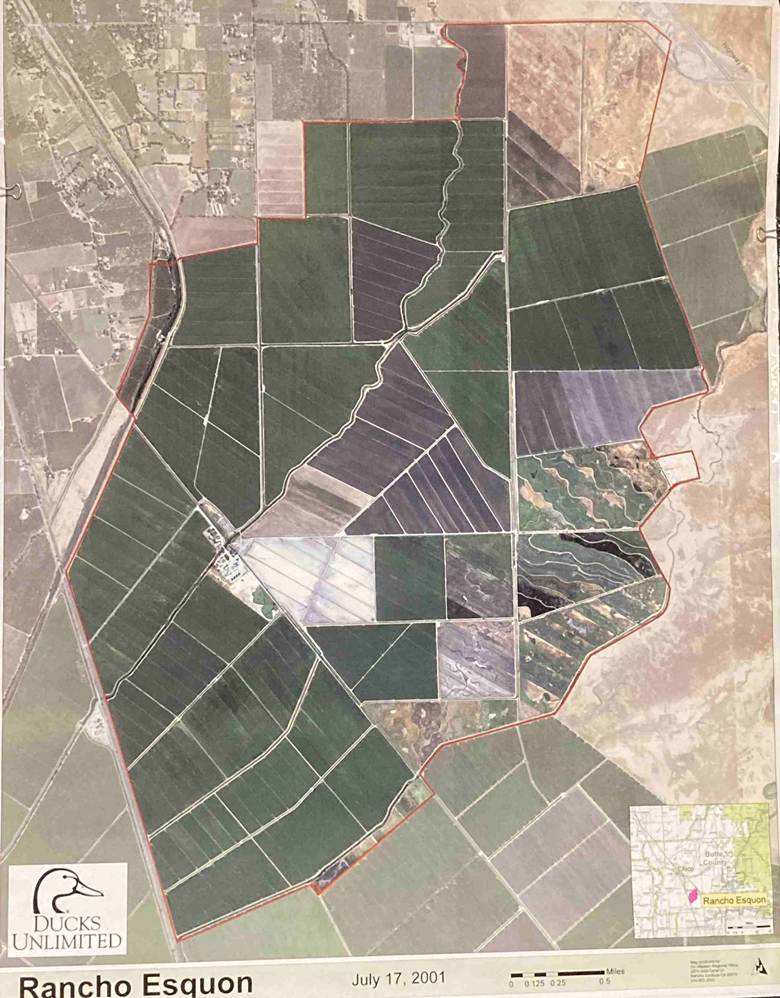
meeting was at Rancho Esquon, We had 10 Rotarians at the
meeting. We didn't do any sort of formal meeting format, we
didn't do a Flag Salute or Invocation because as soon as everyone
had arrived, 5:35pm, Rayme Antonowich wanted to get us back
outside while it still had some daylight, for a short tour since
it really was bitterly cold outside, especially with the
wind! Once indoors,inside what was once the bunkhouse for
the ranch hands and is now a beautiful large room that is built
like a log cabin, we were able to thaw out a bit and could see all
sorts of taxidermy creatures found on the ranch and many
professionally done poster of land mammals, water fowls, and
vegetation that thrives here. Enchiladas, rice and beans,
chips and salsa from Pueblito's, soft drinks and water, were all
provided for our shared meal by President Tom. A big THANK
YOU to Tom for doing this! In attendance were:
Mike, Larry, Steve Plume, Tom, Peggi, Imogen and husband, Steve,
Rebecca Oberdorf, Shane Oberdorf, Carl Ochsner, and Rayme.
|
| 2026
Calendar for Durham Rotary |
F
e
b
r
u
a
r
y |
1
|
2
|
3
Tina Wolfe on CASA
(Peggi Kohler) |
4
|
5 |
6 |
7 |
| 8 |
9 |
10
Board Meeting at 5:30 PM via ZOOM |
11 |
12 |
13 |
14 |
15
|
16 |
17
This meeting will commence at 5:30 PM. Eric Hoiland will
present the program at Rancho Esquon, 1609 Adams Ranch Road,
Durham
|
18 |
19 |
20 |
21 |
| 22 |
23
|
24
No Meeting
|
25 |
26 |
27 |
28
|
M
a
r
c
h
|
1
|
2
|
3
Interact Club Takeover
(Diana Selland & Jessica Thorpe)
|
4
|
5
|
6
|
7
|
8
|
9
|
10
No Meeting
|
11
|
12
|
13
|
14
|
| 15 |
16
|
17
No Meeting |
18
|
19
|
20
|
21
|
22
|
23
|
24
Alisha Rock onChico Airport |
25 |
26 |
27 |
28
|
| 29 |
30
|
31
No Meeting |
|
|
|
|
|
FUTURE
MEETINGS: Meetings
will be at the location noted, at 6:00 pm.
|
|
March
3rd: Jessica & Diana-Interact Takeover
March
24th Tom Knowles will present a program
about rice farming at the BCCC.
April
7th: TBA
April
21st: Diana and Jessica will present the
Student Awards Banquet at the Memorial Hall
May 5th: TBA
May
19th: Steve Heithecker will host us
at the Patrick Ranch.
|
Announcements
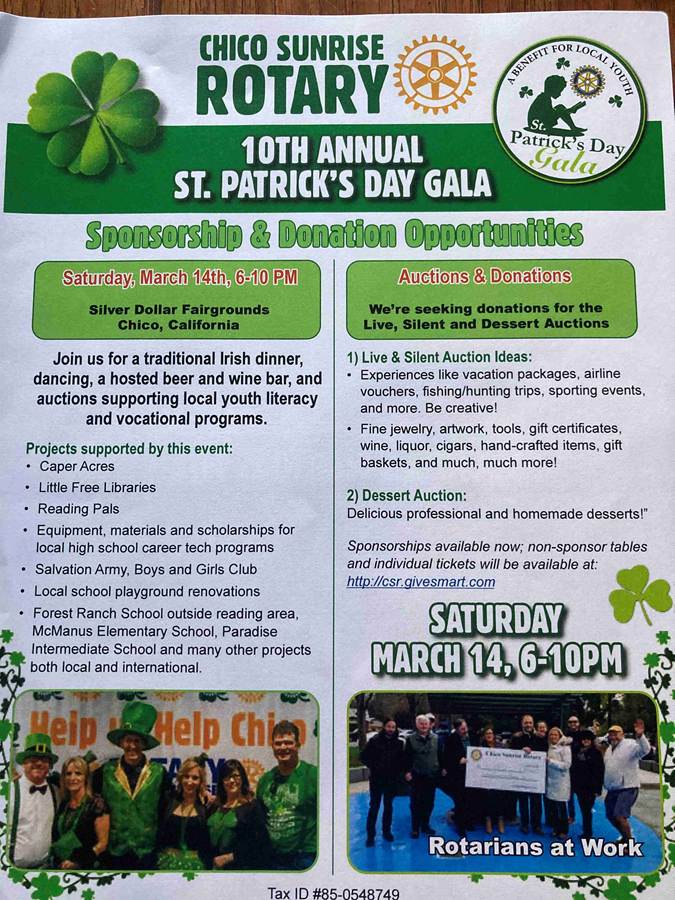
One of the Rotarians attending was Chico Sunrise Rotarian, Carl
Ochsner. He wanted to share and promote their club's 10th Annual St.
Patrick's Day Gala on Saturday, March 14th, Silver Dollar Fairgrounds; and
their International Service Project ~ 'Give Hope - Give a Hand Project',
slated for March 25-31, 2026, in Guadalajara, Mexico. See the
announcement at the end of this Rowel.
Introductions
as noted
above, we had Carl Ochsner from the Chico Sunrise Rotary Club
Recognitions
None
tonight
The
Program
The
program
was a visit to Rancho Esquon, organized by . Tom Knowles.
We were guided around various parts of the Rancho by Rayme
Antonowiich.
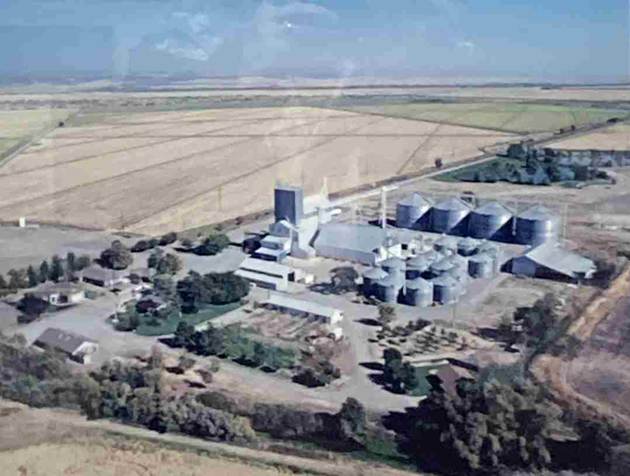
The Rancho has an interesting history. In the history below
you can see where the names of Durham, Gridley and Neal Road came from.
Rancho Esquon (also
called Neal's Rancho) was a 22,194-acre (89.82 km2) Mexican land grant in
present-day Butte County,
California given
in
1844 by Governor Manuel Micheltorena to
Samuel
Neal.[1] The grant, located south of
present-day Chico, extended on the east
bank of Butte
Creek,
and encompassed present-day Durham,
Esquon, Gridley,
and Nelson.[2] Rancho Aguas Frias was
directly
across Butte Creek.
History
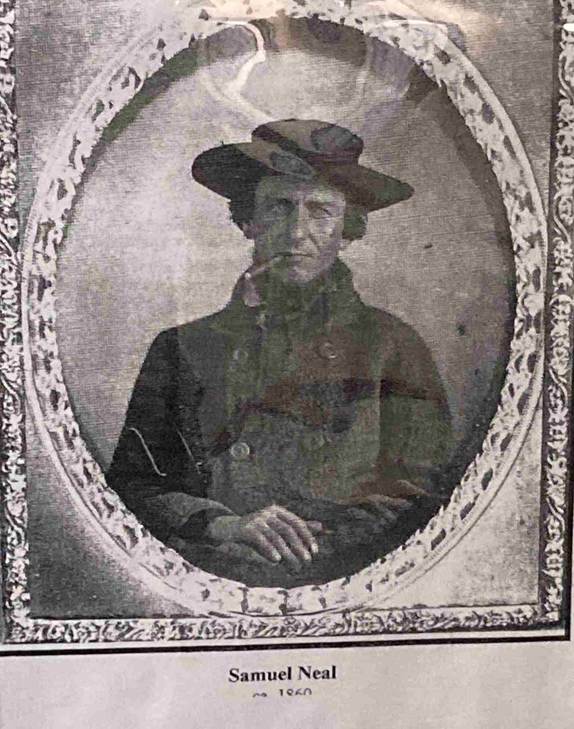
Samuel Neal (1816–1859), a native of Pennsylvania and a
blacksmith by trade, came to California with John C. Frémont's
second expedition in 1844. After working for John Sutter briefly, Samuel
Neal was awarded the five square league Rancho Esquon grant in 1844.[3] In 1849, Neal mined gold on
the Feather River at a location that became known as Neals Diggins.[4] For six years David Dutton
worked with Neal on the Rancho.
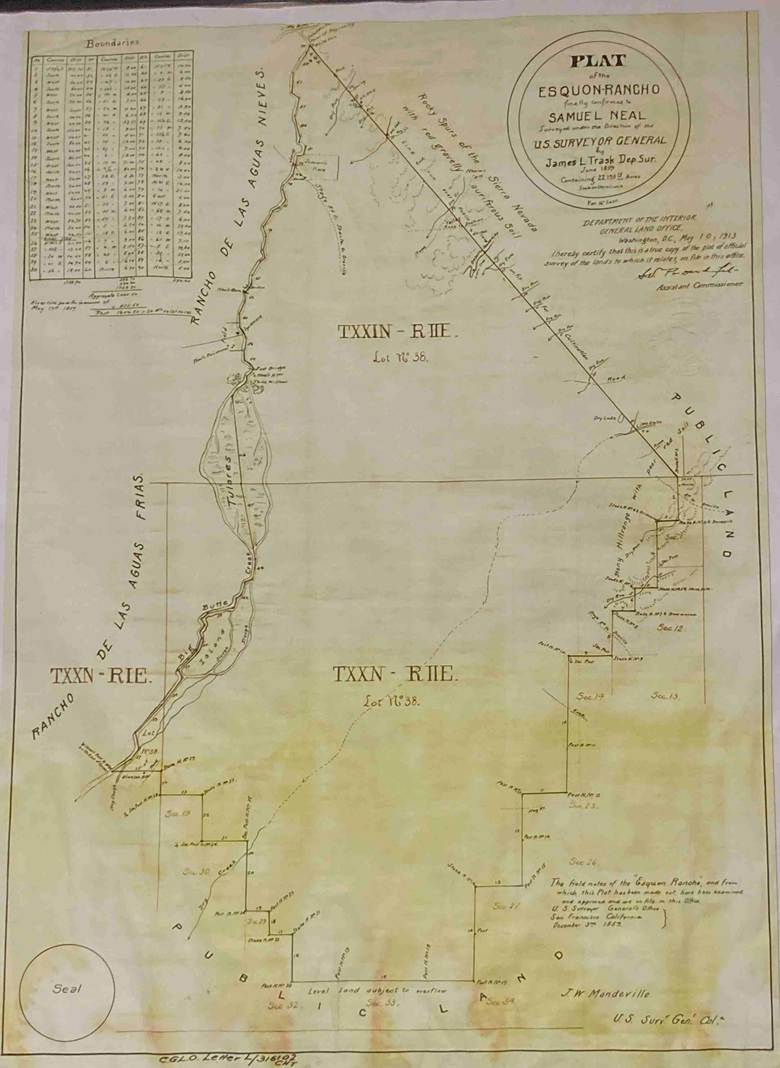
With the cession of
California
to the United States following the Mexican-American War,
the 1848 Treaty of
Guadalupe Hidalgo provided that the land grants would be honored. As required
by the Land Act of 1851, a claim for Rancho Esquon was filed with
the Public Land Commission in
1852,[5][6] and the grant was patented to
Samuel
Neal in 1860.[7]
Upon his early
death in 1859, Neal willed most of his land to R.W. Durham. Robert
Waddell Durham(1818–1871), a partner in the Waddell branch of the Pony Express,
came to California from Missouri. Durham became a close
friend of Samuel Neal, and worked as Neal's business manager at the
ranch. Durham, an early farming community, was settled by R.W. Durham
and his brother, William W. Durham (1811-1873), in 1852. Like Neal,
Durham never married and having no children of his own, sent for his
nephews (sons of his other brother George Durham), George W. Durham
(1834–1880) and William Wellington Durham (1844–1907) from Missouri, to
assist him in managing the inherited rancho.[8]
In 1868, R.W.
Durham sold 17,800 acres (72.0 km2) in the southerly part
of Rancho Esquon to George Gridley and his eldest son, C.E. Gridley.
George Gridley was a sheep rancher. R.W. Durham died in 1871, and his
elder brother William died in 1873, and their portion of the rancho was
subdivided in lots and sold. In 1879 George Gridley sold his 17,800
acres (72.0 km2)
to E.B. Pond, John Boggs and C.W. Clarke, who then sold them to Leland Stanford in
1880.[9] The Stanford-Durham Ranch
later became the property of Stanford University.
Over
the years, the land evolved into a prominent agricultural hub, beginning
with E.L. Adams in the early 20th century who pioneered rice farming,
earning him the title of, 'Father of the Rice Industry of
California'. Since 1993, when Ken Hofmann and family from the Bay
Area purchased the ranch, they've focused on sustainable farming
practices of rice and several acres of almond orchards,along
with significant wildlife habitat restoration. Mr.
Hofmann in the early 2000's was instrumental in turning
approximately 950 acres of the ranch into a thriving habitat of wetlands
and planting thousands of cottonwood and willow trees, making it a
self-contained eco-system, promoting an ideal setting for migrating
birds and local birds alike of nearly 100 species. General Manager
Rayme Antonowich was a key player in planting thousands of these
trees! This of course has brought in some mammals that are
welcomed and some that are a nuisance, and the ranch is careful on how
to keep that balance. Butte Creek runs through the property and
most years salmon use this water way as a means to travel. The
name, 'Esquon' is derived from a Native American tribe that once lived
along Butte Creek. In the recent past, pre-covid, many educational
classes and field trips were conducted here, and Mr. Antonowich would
love to see this aspect return. The late Mr. Hofmann's genuine
desire to giveback to the community continues to this day, with a famous
quote he shared, 'Give until it hurts, then give some more'. There
is a large Community Youth Center still operating in Concord, CA,
started by Mr. Hofmann, serving underprivileged youth free services in
every aspect of tutoring, mentor-ship,coaching of various sports'
opportunities, all in a positive and safe environment.
Next Meeting
The
next meeting, on March 3rd at Butte Creek Country Club.
Jessica & Diana will introduce the Durham High School,
Interact Club. They will then take over the meeting.
Thanks
to Peggi:
I
want to thank Peggi Koehler for providing me information and photos for
the Rowel, since I did not attend. The history of Rancho Esquon above is
a combination if information from Peggi and what I found on line.
The photos are all from Peggi, although it did not use all she
sent. If I had put the photos she took of members I would have had
to use all of them (since there were only a few members in each photo),
and that would have been too many.
Membership
Bring
guests who you think you can interest in becoming a member. We Need More Members! Your
dinner and your guest’s dinner will be paid for by the Club. Also,
bring a guest to one of our occasional social gatherings.
President
Tom is asking the members to bring in new members this year.
Go to the
following Rotary International web site for information on membership
development: https://my.rotary.org/en/learning-reference/learn-topic/membership
.
From this website there is access to membership development and
other related information.
The
Rotary Foundation Donations
You can make a difference in this world by helping
people in need. Your gift can do some great things, from supplying
filters that clean people’s drinking water to empowering local
entrepreneurs to grow through business development training.
The Rotary Foundation will use your gift to fund
the life-changing work of Rotary members who provide sustainable
solutions to their c ommunities’ most pressing needs. But we need help
from people like you who will take action and give the gift of Rotary to
make these projects possible.
When every Rotarian
gives every year, no challenge is too great for us to make a difference.
The minimum gift to The Rotary Foundation is $25.00. An
annual $100.00 gift is a sustaining member. Once your donations
accumulate to $1,000 you become a Paul Harris Fellow.
If you have any
questions, ask Steve Heithecker.
It is possible to learn more about The Rotary
Foundation on the Rotary web site.
Your gift can be made online or by sending Jessica
Thorpe a check made out to The Rotary Foundation to Durham Rotary,
P.O. Box 383, Durham, California 95958.
The latest District Newsletter has been uploaded
to DACdb - to view it there go to the District tab, open the District
Bulletin file andlook for the pdf file named Rotary District 5160
Newsletter.
From
Rotary International’s News and Features Website
{Note
that the proceeding may not be the complete article. See the
complete article on Rotary International’s web page.}
Note that the
photos in the original article may not have been reproduced here.
Rotary’s alumni honoree works to transform mindsets in peace
building efforts
By Amy
Hoak
As
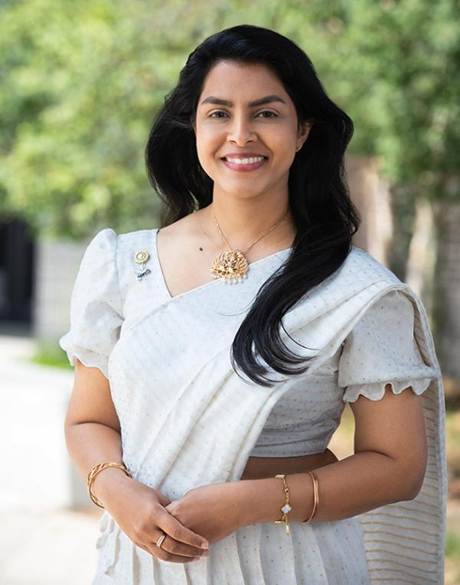
a child during Sri Lanka’s 26-year civil war, Pushpi Weerakoon planned
to become a lawyer. “I was born into a civil conflict, walked minutes
away from bomb blasts, and saw parents of my schoolmates killed,”
Weerakoon said. “From a very early stage, I understood the cost of
conflict, and I knew I had to do something about it.”
In
1999,
with Sri Lanka a member of the British Commonwealth, Weerakoon headed
tothe University of Buckingham in the UK. There she earned a bachelor of
law and a postgraduate diploma in international and commercial law.
Weerakoon
fully
intended to continue traveling down the barrister’s path, but nature
intervened. She was visiting Sri Lanka from England when, on 26 December
2004, an earthquake erupted beneath the Indian Ocean off the northwest
coast of Sumatra, an Indonesian island. The most powerful earthquake
ever recorded in Asia and one of the deadliest natural disasters in
history, it spawned amonumental tsunami that hit Sri Lanka and more than
a dozen other countries and left more than 220,000 people dead.
Image
credit:
Monika Lozinska
Moved
by
the devastation, she began volunteering with groups to help survivors.
The director of the country’s Alternative Dispute Resolution Institute
asked her to train grassroots leaders in mediation, drawing on her law
education. “After the tsunami,” Weerakoon explained, “so many small
claims clogged up the main court system.” It was hoped that those newly
trained leaders could help resolve contentious issues in Sri Lanka’s
well-established community-based mediation boards.
She
traveled
throughout the country holding mediation workshops for three weeks of
every month for two years. Because the country was approaching the final
stages of the civil war, she was accompanied by members of the military
into highsecurity zones.
“Remember,”
she
said, “I was trained to be a lawyer, where you think in terms of black
and white and then punishment.” But in a situation where combatants on
both sides think they’re right, Weerakoon continued, “that’s not a
matter of black and white. It’s a matter of transforming mindsets, about
opening up and sharing thoughts and values and ideas — and the law
doesn’t exactly help that.
“With
that
thought, I came back home, and that was it. I decided I’m not going to
bea traditional lawyer.”
What
followed
were years of additional study and an impressive aggregation of degrees
on her way to becoming an internationally respected peace builder,
supported by Rotary at multiple steps along the way. She received an MBA
from the University of Wales, a master’s in conflict transformation at
Eastern Mennonite University (with the help of a Rotary Ambassadorial
Scholarship), a master’s in public administration from the John F.
Kennedy School of Government at Harvard University, and a PhD in peace
and conflict studies at the University for Peace.
Pushpi
Weerakoon
- Rotary
Peace Fellowship, 2007
- Rotary
Ambassadorial Scholarship, 2009
- Rotary
Alumni Global Service Award, 2024-25
She
also
studied at the Rotary
Peace
Center at Chulalongkorn University in Bangkok,
earning a diploma in peace studies and conflict resolution. “Chula was
veryhands-on,” said Weerakoon, clearly impressed with the peace center
program. “It’s not this theory and that theory. It was very practical:
If it’s a class on mediation, you sit down and actually mediate.”
There
were
also trips in the field where peace fellows interacted with Indigenous
people whose lives and livelihoods were threatened by plans for a
hydroelectric dam. “What Rotary exposed me to was like gold,” she said.
“The experience tosee it, and then now having to actually do it.”
Impressive
as
they are, Weerakoon’s academic achievements served more as
steppingstones rather than as goals in themselves. In Sri Lanka, she
served as the coordinator of the National Reconciliation Secretariat
and, in 2016-17, the civil society coordinator for the country in
the Open
Government
Partnership, a global
initiative that promotes collaboration between government ministries and
nongovernmental organizations. In that role, she helped craft a national
action plan to address crucial issues related to health, the
environment, corruption, and access to information.
For
the
last nine years, Weerakoon has worked at the United Nations International
Organization
for Migration, where she has
taken leading roles not only in Sri Lanka, but in such far-ranging
destinations as ElSalvador, the Bahamas, and Micronesia, mediating
disputes, supporting disaster recovery, and combating sexual violence.
In Bangladesh, home to Kutupalong, the largest refugee settlement in the
world, Weerakoon served as IOM’s refugee support officer. In that
capacity she helped design a social cohesion strategy and coordinated
efforts to address the Rohingya refugee crisis.
At
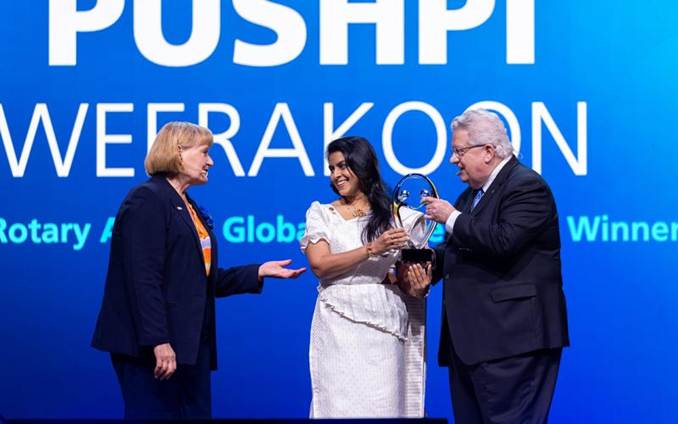
the convention in Calgary, Weerakoon receives the Rotary Alumni Global
Service Award from Rotary leaders Stephanie Urchick and Mark Maloney.
Image credit: Christophe Viseux
In
June,
Weerakoon was honored for her work with the Rotary Alumni Global Service
Award at the Rotary International
Convention in Calgary. During her seven-minute speech, she challenged
Rotary members to ensure that graduating peace fellows have the
resources to best employ their newly acquired skills. “Rotary does not
just spark change,” she said. “It cultivates generations of it. Let’s
make sure we have the valuable insights from the post-fellow fraternity
… that will help Rotary build a mechanism to continue to carry the
legacy forward.”
Her
speech
offered only hints of the things she has accomplished as an
internationally respected peace builder. Instead, she emphasized how
Rotary had been there for her at each step of her life’s journey. “What
Rotary gave me wasn’t just scholarships,” she said. “It was a family, a
belonging. It was the certainty that, no matter where I am, I would not
be alone.”
This
story
originally appeared in the January 2026 issue of Rotary magazine.
© 2026 Rotary International. All
rights reserved. Privacy
Policy
Terms of Use
|
The Rowel Editor
may be contacted at:
pbprice1784@gmail.com
The deadline for
the Rowel 6:30 am on
Wednesdays.
The Editor's
photographs published in the Rowel are available, upon
request, in their original file size.
Those published were substantially reduced in file
size.
|