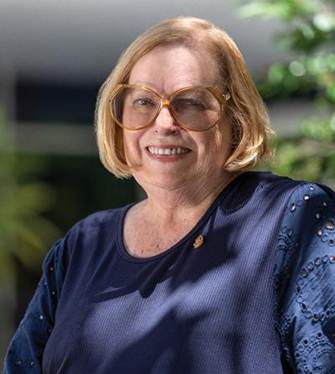
Jessica Thorp announced that the scholarship recipients had been
determined. We are awarding $22,000
in scholarships this year.
She
also announced that the Camp Royal attendees had also been determined.
Also, don’t forget the Butte County Search &
Rescue Gala in the Sierra Nevada Big Room on April 18th.
Tickets
are $150 per person and are available through Eventbrite.com
Next Meeting
The
next meeting, on April 21st, will be at the Memorial Hall,
in Durham. Jessica and Diana will present the program, which
will be the awarding of the scholarships. However, we will also
have two Students of the Month and the Camp Royal students.
Also, if selected by then, the Teacher of the Year.
The Program
The program was presented by Rebekah
Oberdorf. We had dinner outside.

Then
She talked about Nascere Vineyards, where she works. She told us
about the history of the vineyard and how they got into wine
making. We then went into the building to taste their
wine. Although some of us had gone in before dinner and
gotten a glass of wine to have with dinner.
Recognitions
Peggy
will have an anniversary on April 30th. She
contributed $40. She thought $4 for 4 years was not enough.
Somebody
else will have an anniversary on April 22nd . (forgot
to write the name down). He contributed $28.
The
President’s wife, Sara, has a birthday. He contributed $54.
Mike
Crump contributed $75 for his birthday.
Jessica
contributed $35 for her birthday on April 4th.
There
were so many that I may have missed one. I apologize, if I did.
Membership
Bring
guests who you think you can interest in becoming a member. We Need More Members! Your
dinner and your guest’s dinner will be paid for by the Club.
Also, bring a guest to oneof our occasional social gatherings.
President
Tom is asking the members to bring in new members this year.
Go to the
following Rotary International web site for information on membership
development: https://my.rotary.org/en/learning-reference/learn-topic/membership
.
From this website there is access to membership development and
other related information.
The
Rotary Foundation Donations
You can make a difference in this world by helping
people in need. Your gift can do some great things, from supplying
filters that clean people’s drinking water to empowering local
entrepreneurs to grow through business development training.
The Rotary Foundation will use your gift to fund
the life-changing work of Rotary members who provide sustainable
solutions to their communities’ most pressing needs. But we need help
from people like you who will take action and give the gift of Rotary
to make these projects possible.
When every Rotarian
gives every year, no challenge is too great for us to make a
difference. The minimum gift to The Rotary Foundation is
$25.00. An annual $100.00 gift is a sustaining
member. Once your donations accumulate to $1,000 you become a
Paul Harris Fellow.
If you have any
questions, ask Steve Heithecker.
It is possible to learn more about The Rotary
Foundation on the Rotary web site.
Your gift can be made online or by sending Jessica
Thorpe a check made out to The Rotary Foundation to Durham Rotary,
P.O. Box 383, Durham, California 95958.
The latest District Newsletter has been uploaded
to DACdb - to view it there go to the District tab, open the District
Bulletin file and look for the pdf file named Rotary District 5160
Newsletter.
Spring Assembly is
coming up, April 11, 8:30 to 2 PM, at Shasta College's Downtown
Redding Campus, 1400Market St. If you haven't had a chance to
register, do it now.
Must
Be Present to Win Drawing:
From
Rotary International’s News and Features Website
{Note
that the proceeding may not be the complete article. See the
complete article on Rotary International’s web page.}
Note that
the photos in the original article may not have been reproduced here.
As
the
science advances, Rotary members join the quest to find malaria
vaccines
By Ruby
Prosser Scully Photography by Rhys Martin
At first it just
seemed like a bad flu.
The illness struck
Danielle Stanisic while she was in New York for a research gig, her
first time living away from home in Australia. It was her lab mates,
though, who grew alarmed and insisted she get tested. It turned out
Stanisic, who had traveled to Papua New Guinea six months earlier, had
malaria.
The next week in the
hospital was a blur of suffering, but looking back 20 years later,
Stanisic’s overriding feeling about the ordeal is how lucky she was.
“I had access to rapid and effective care in a hospital,” she says. “I
didn’t have to worry about the drugs being counterfeit. I didn’t have
to worry about them not having enough IV fluids. I didn’t have to
worry about any of that. That’s not the way it is in malaria endemic
countries.”
Today,
Stanisic
is a veteran immunologist specializing in defeating parasites. Atop
her hit list is the biological invader that causes malaria, a killer
of around 600,000 people each year, most of them in places offering
little of the luck that she had accessing care.
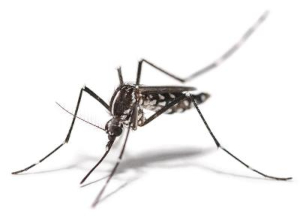
Image credit: Getty
images
An age-old danger
Malaria has
bedeviled humankind for millennia. Caused by a mosquito-borne
parasite, the disease has afflicted generations stretching back to the
likes of Alexander the Great, believed to have been killed by the
illness on the banks of the Euphrates. Traces of malaria parasites
have been found, too, in mummified remnants of Tutankhamen’s blood.
Today, though the
disease is preventable and treatable, malaria remains a deadly and
destructive force in large swaths of the world, nowhere more so than
in Africa, home to 95 percent of cases and deaths. In 2024, malaria is
estimated to have sickened 282 million people and killed 610,000,
about 75 percent of them under the age of 5.
The disease is
spread to humans through the bite of some female Anopheles mosquitoes.
The most common symptoms are fever, headache, and chills. If left
untreated, the infection can lead to severe illness with fatigue,
seizures, and difficulty breathing, and may cause coma or death in as
little as 24 hours from the onset of symptoms. Though malaria is not
contagious or spread directly from person to person,mosquitoes feeding
on an infected person’s blood can pick up the parasite and spread it
to other people.
In the first two
decades of this century, the risk of malaria gradually dropped in
affected areas, with the biggest factor by far being the adoption of
preventive measures like bed nets treated with insecticides that can
last three years or more and spraying interior walls with similarly
long-lasting insecticide. Aided by such measures, 47 countries have
been certified malaria-free by the World
Health
Organization, including Egypt, China, and,
most recently, the Democratic Republic of Timor-Leste in 2025.
Antimalarial drugs also saved lives.
Since the start of
the COVID-19 pandemic, however, case counts have grown again. And
global cuts to aid funding could trigger a further devastating
reversal of the progress. “A perfect storm of climate change, rising
drug and insecticide resistance, trade disruptions, and global
insecurity further undermine the efficacy of malaria interventions and
threaten to reverse the hard-won progress that has been made since
2000,” warns a 2025 report by the intergovernmental African
Leaders
Malaria Alliance and the
nonprofit Malaria
No
More UK. Last year’s round of pledges to the Global Fund partnership,
which raises money to fight malaria, AIDS, and tuberculosis, produced
less than the previous round, in 2022. The report’s authors predict
that failing to match the earlier level of funding will result in an
even greater increase in the number of malaria cases and deaths.
The WHO’s approval
starting in 2021 of two breakthrough vaccines for malaria — the first
ever against parasites — is giving hope that this dire forecast can be
averted and even that the disease could be eradicated. Dozens of other
possible vaccines are in the pipeline. Among them is a promising
candidate being developed by Stanisic and her team in Australia.
For decades,
scientists have puzzled over how to train the body’s immune system to
fight malaria more effectively. The parasites that cause the disease
have existed for millions of years, so we have evolved together,
trapped in a relentless war of biological one-upmanship. In some
malaria-prone areas, for instance, gene mutations in humans changed
the shape and behavior of red blood cells. One example, the
sickle-cell trait, can cause red blood cells infected with the malaria
parasite to self-destruct along with the invaders.
At the same time,
the cunning parasite developed sophisticated ways of dodging our
bodies’ defenses. Malaria parasites shape-shift during their life
cycle, dramatically changing forms and surface features. This is a
problem for our immune system’s beat cops, or antibodies, which sketch
mug shots of pathogens to quickly identify them and call for
reinforcements if they’re spotted again.
Modern
vaccines,
including the two malaria shots approved so far, train the immune
system often with only part of a single surface protein from that
pathogen. It’s a safe way for antibodies to draw that wanted poster
without risk of an actual infection. But malaria parasites are masters
of disguise and can rapidly change themselves to evade the human
immune response.
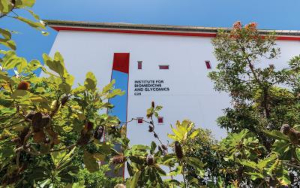
Researchers
at
Griffith University’s Institute for Biomedicine and Glycomics are
developing a potential vaccine candidate, called PlasProtecT.
Developing a new
vaccine
Gum trees sway
lazily in the hot breeze around Griffith University’s Institute
for Biomedicine and Glycomics,
while tourists crowd the nearby beaches on Australia’s Gold Coast.
It’s here that Stanisic and fellow immunologist Michael Good, the
project’s principal researcher, are developing their potential vaccine
candidate, called PlasProtecT, with the help of a fundraising
partnership with Rotary clubs in Australia.
Here, in a busy lab,
fridges hum and researchers peer down microscopes as they tap to count
parasites.Upstairs in Good’s office, the desk is piled with research
papers, biology magazines, and conference programs. Behind him is a
framed picture of multiple malaria parasites, an image captured by
pioneers of the field in the 1800s. An award plaque lies, seemingly
forgotten, on the bottom of his bookshelf.
Good has dedicated
40 years to researching malaria parasites. During an early vaccine
experiment about a decade ago, his team injected him with Plasmodium
falciparum, the deadliest species of malaria parasite. Voluntary
self-experimentation has been a common practice in medical research
historically, if less so currently, and Good felt it was important. “I
wanted to be able to say, ‘Well, I’m prepared to take it.I’m not going
to give you anything that I wouldn’t be prepared to take myself,’”
Good says.
The parasites were
live but weakened in a process known as attenuation, which renders
pathogens harmless while keeping them recognizable to the immune
system. It’s the same process used safely in vaccines for everything
from chickenpox to the flu.
The
parasites
in this early test had not been weakened enough, and Good was soon
shivering under a pile of blankets at home in bed. But like Stanisic,
he was in close reach of world-class care and quickly recovered.
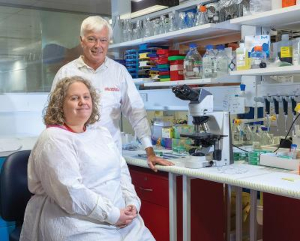
Danielle
Stanisic
and Michael Good, of Griffith University’s Institute for
Biomedicineand Glycomics, are developing a potential malaria vaccine
candidate with the help of a fundraising partnership with Rotary clubs
in Australia.
The episode sent the
researchers back to the drawing board to tweak the formulation, while
also providing backing for some of their broader approaches. Today,
they freeze the parasites to kill — not just weaken — them, bundling
the shattered components into a fatty sac with other compounds to
boost the immune response. There is no risk of malaria infection from
this test version. “This sucker has been killed by freezing it,” Good
says. “It’d be like putting a person into a tank of liquid nitrogen
and pulling them out and hoping that they’re going to walk away.
Theywill not.”
When a malaria
parasite-infected mosquito bites a person, tiny worm-shaped parasites
escap ethe insect’s salivary glands and sneak into the skin. These
forms of the parasite, known as sporozoites, burrow down into the
bloodstream where they make their way to the liver within minutes or
hours. There, they grow and divide for about a week, transforming into
egg-shaped forms known asmerozoites. When these merozoites have fully
matured, about 30,000 of them burst out of the liver, ready to invade
red blood cells.
The merozoites latch
onto a red blood cell, drill a hole, squeeze inside, and seal the door
to hide from the immune system. Once inside, the parasite begins
gobbling up hemoglobin protein, dividing again and again until around
two dozen copies are pressed against each other like people on a
packed dance floor.
The cell walls
burst, flinging new merozoites into the bloodstream. And the cycle
starts again.
This is when hosts
start to show symptoms. As merozoites rupture the cell walls, waste
products flood the bloodstream, triggering a massive immune response
with fever and chills.
Malaria’s
destruction of red blood cells can lead to anemia, fatigue, aches, low
blood oxygen, and even organ damage. It can happen so quickly that by
the time children reach the hospital they are in urgent need of a
blood transfusion.
If left untreated,
people can die from malaria, sometimes within just 24 to 48 hours. The
most at risk arechildren, pregnant women, immune-compromised people,
and those who have never been infected before.
The two vaccines
with WHO approval currently in use, Mosquirix and R21, have been shown
to reduce malariacases in children by more than 50 percent during the
first year after the initial series of three doses. (After a year, a
fourth dose is recommended to prolong protection, which wanes over
time.) In areas with highly seasonal transmission for a few months of
the year, they prevent around 75 percent of cases when given
seasonally. They’re being offered to children in 25 countries in
Africa alongside routine childhood immunizations with the aim of
reaching more than 10 million children a year — a target that is so
far at risk from limited funding.
Based on modeling,
these vaccines could save the lives of an estimated half a million
children by 2035if distribution were scaled up in areas of moderate
and high transmission, WHO says.
Meanwhile, more
tools and vaccines are on the horizon, including Griffith University’s
PlasProtecT, which is on the cusp of clinical trials thanks to more
than AU$3.1 million (about US$2.2 million) raised by Rotary District
9640.
It differs from the
other vaccines used in the field, including by targeting the malaria
parasite afterit has traveled out of the liver and entered the
bloodstream. “By only having vaccines that target the liver stage of
infection there’s a danger that it just takes one parasite to escape
from the liver to start the blood stage of infection,” says Christian
Engwerda, a cellular immunologist at the QIMR
Berghofer
Medical Research Institute in Brisbane.
“In the ideal world, you’d have a vaccine that did all three things:
prevented liver infection, prevented blood stage infection, and
prevented transmission back to the mosquitoes.”
The PlasProtecT
vaccine can also be frozen or freeze-dried into a powder without
affecting its efficacy,making it easy and cost effective to transport.
And it contains more than 5,000 malaria parasite proteins, offering
protection against a wider range of parasite strains and species — an
approach known as a whole-parasite vaccine.
Phase 1 clinical
human trials for PlasProtecT are set to begin this year. Early tests
of the immunization showed promising signs. “Our preclinical models
show that this whole-parasite vaccine approach stimulates very good
immune responses and against different strains,” says Stanisic.
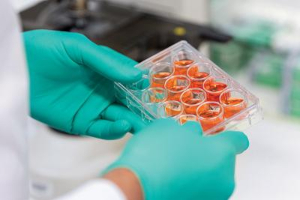
The
PlasProtecT
vaccine candidate being developed by Griffith University researchers
can be frozen or freeze-dried into a powder without affecting its
efficacy, making it easy and cost effective to transport.
Her bout with the
disease points to another need for multiple tools against malaria,
including vaccines.During her trip to Papua New Guinea all those years
ago, Stanisic, like many travelers, preventively took antimalarial
medication, which kills malaria parasites in the bloodstream. But in
her case, some of the invaders lay dormant in her liver, only emerging
months later after any medication was gone — a hazard associated with
two of the five malaria parasite species.
“That’s why a highly
effective vaccine is what we need,” she says, “something that will
allow you to develop your own immunity and stop the parasite
developing in the blood.”
Rotary helps bridge
funding gaps
The philanthropic
and government sectors are awash with debate over which public health
campaigns andtools to back with limited resources and which hold the
most promise. Some governments are reducing commitments across the
board. Stanisic is blunt in harassment that scientists face what they
call “valley of death” funding gaps that cause promising technologies
to die.
Early on, her team
turned to Rotary for support. Stanisic regularly spoke to a group of
Australian Rotary members focused on eliminating malaria, and in 2015
she joined a new Rotary satellite club based at Griffith University.
After she appealed for funds tobuy a piece of lab equipment, Rotary
members enthusiastically raised the money in a week. One of them,
Sandra Doumany, immediately saw the potential for Rotary clubs to get
more involved. “What that showed was the power of Rotary,” says
Doumany, a member of the nearby Rotary Club of Hope Island and a past
district governor. “The fact that we could respond within the week, to
me, that was the power of Rotary.”
Rotarian
Sandra
Doumany has helped lead fundraising efforts to keep the research going
at the Griffith University lab.
In 2017, the Malaria
Vaccine Project launched as a formal partnership between the Griffith
researchers and Rotary District 9640. The project’s goal is to raise
the funds needed to keep research going through the vital Phase 1 and
2 trials, typically the point when government funding ends and
industry funding is yet to start.
Doumany chairs a
leadership committee for the Malaria Vaccine Project and organizes an
annual black-tie fundraiser; the most recent one raised about
AU$86,000 (US$56,000). Project members also hold golf days, boat
shows, barbecues, and meetings to promote the work and find donors.
Another Rotarian
helping to lead efforts is Ross Smith, an upbeat retired school
principal and member of the Rotary Club of Burleigh Heads. The past
district governor travels the world tirelessly drumming up support for
the campaign and hardly had time to shake off the jet lag from a
recent international trip before attending the latest black-tie
dinner. “Malaria is the cause of the most deaths on the planet,ever,”
Smith says. Still, he adds, fundraising can be a challenge when
malaria predominantly affects poorer regions of the world.
For Smith, it’s far
from an abstract illness. His father caught the disease several times
as a prisoner ofwar to the Japanese during World War II in Singapore.
More than half a century later, Smith had his own experience with the
parasite while spending time at a small school in Tanzania for a
Rotary project. One night, an Australian woman working at the school
had come down with what turned out to be malaria and needed to get to
a hospital. Smith drove her. “She was sweating and bloated. She looked
so unwell,” Smith remembers. On the tense drive, 5 miles in the dark
over a heavily rutted road, Smith wasn’t sure she would make it. He
felt helpless. After several days in the hospital, she pulled through.
Rotarian
Ross
Smith, who has seen the effects of malaria firsthand, travels the
world to bolster fundraising efforts.
Smith had always
been inspired by Sir Clem Renouf, the former Rotary International
president who helped start the organization’s fight against polio. And
Smith’s trip to the Tanzanian hospital energized him to tackle
malaria. He thinks Rotary’s progress toward polio eradication can be a
good model for fighting malaria — if scientists can find the right
vaccines.
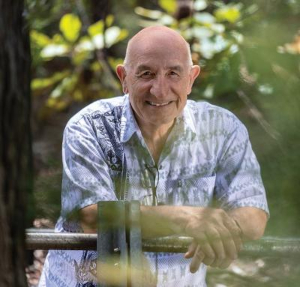
Dan Perlman, chair
of the Rotarians Against Malaria-Global Rotary
Action
Group, believes the advances in vaccines, alongside better control
measures, make the eradication of malaria a real possibility. The
action group supports projects that provide mosquito nets, drain
stagnant water, deliver larvicides and indoor residual spray, and
train community health workers to diagnose and treat uncomplicated
malaria and refer more complicated cases. In countries where malaria
vaccines have been introduced, community health workers are educating
people about them to support vaccination campaigns.
“Vaccination is
clearly the key to eradicating malaria,” says Perlman, a retired
infectious disease physician who became one of the first American
doctors to vaccinate an infant against malaria when he visited Uganda
during its initial roll out of the vaccinelast year. He highlights
challenges with the first-generation vaccines, such as the need for
four doses and their waning protection over time, but believes we are
in the middle of a “vaccine revolution” that will see several
next-generation vaccines rolled out in coming years. “I imagine that
in less than a decade from now we’ll have at least three or four
approved vaccines for malaria: We’ll have a travel vaccine, and we’ll
have a vaccine for adults,”says Perlman, a member of the Rotary Club
of Carbondale, Colorado.
Rotary members
recently celebrated WHO’s certification of Timor-Leste as
malaria-free. They have been supporting the Southeast Asian island
country and other countries in the region by distributing insecticidal
nets, providing residual spraying machines and diagnostic tools, and
running community education campaigns.
“In the next 30 to
40 years there’s a high likelihood that we will eliminate malaria on
Earth,” says Perlman. “It really will depend on what resources,
funding, and support are put into this.”
Support for
community action
World Malaria Day on
25 April is a chance for Rotary members to make a measurable impact in
communities wherethe disease is endemic. To support those efforts, the
Rotarians Against Malaria-Global Rotary Action Group invited
applications for grants of $2,500each for projects ranging from
distribution of insecticide-treated bed nets and rapid diagnostic test
kits to educational programming in schools and social media campaigns.
The action group
received 91 applications and awarded 33 grants. “The immense creative
energy in these numerous proposals reflects an interest in malaria
eradication that is game-changing,” says Dan Perlman, chair of the
action group. “These grantopportunities change lives, but they also
change us. Rotary grounds us in service, connects us across cultures,
and reminds us that progress happens when people show up with purpose
and dedication.”
Challenges ahead
Despite progress,
the road ahead is uncertain. Funding shortfalls remain a persistent
challenge. WHO had estimated that $9.3 billion per year would be
needed by 2025 to control malaria globally and meet elimination
targets. But only $3.9 billion was spent in 2024.That makes it far
more difficult to meet the global target, set in 2015, of reducing
malaria cases and deaths by at least 90 percent by 2030.
“Insufficient
funding has led to major gaps in coverage of insecticide-treated nets,
medicines, and other lifesaving tools, particularly for those most
vulnerable to the disease,” WHO says. We are already seeing a rise in
drug and insecticide resistance, as well as strains of malaria that
aren’t detected by standard diagnostic tests.
Mosquitoes are
behaving differently too. Climate change is creating new hot and wet
locations for mosquitoes to spread, including the Asian mosquito
species Anopheles stephensi that is invading Africa and thrives in
urban areas. Several species of mosquito are biting outdoors and
during the day, when fewer people are under the protection of a bed
net. “The overall situation is really concerning,” says Eliane
Pellaux-Furrer, a technical officer for malaria vaccines at WHO. “We
also know that malaria is a disease that bounces back very rapidly,”
she says.
Disruptions in
control measures during the COVID-19 pandemic led to a resurgence in
malaria, providing some clue as to what’s in store with funding cuts.
While there has been a “huge demand” and uptake of the current malaria
vaccines, Pellaux-Furrer says,“unfortunately, they’re not able to go
at the scale that they would like to with implementation because of
funding constraints.”
New and better
malaria vaccines will be easier to introduce now that the breakthrough
Mosquirix and R21 vaccines have developed the infrastructure and
vaccine schedules, she says.
Phase 1 trials for
PlasProtecT will cost around AU$10 million, with around AU$30 million
sought for Phase 2 trials to test its efficacy in children in endemic
areas. The Griffith researchers hope that data will be in by 2028 and
the vaccine can berolled out and monitored in several malaria endemic
sites in the years that follow. But science is unpredictable. “You
have to be headstrong,” says Stanisic. Turning to Good, she asks: “How
many times have we thought we’d worked out what we have to do and then
another hurdle presents itself?”
Whatever comes
along, the work that they and other researchers are doing will lead to
other yet unknown advancements. And Stanisic and her colleagues remain
determined and dedicated. As long as the threat lingers, they have to
be, she says. “Kids dying of malaria is what keeps me going.”
This
story
originally appeared in the April 2026 issue of Rotary magazine.